

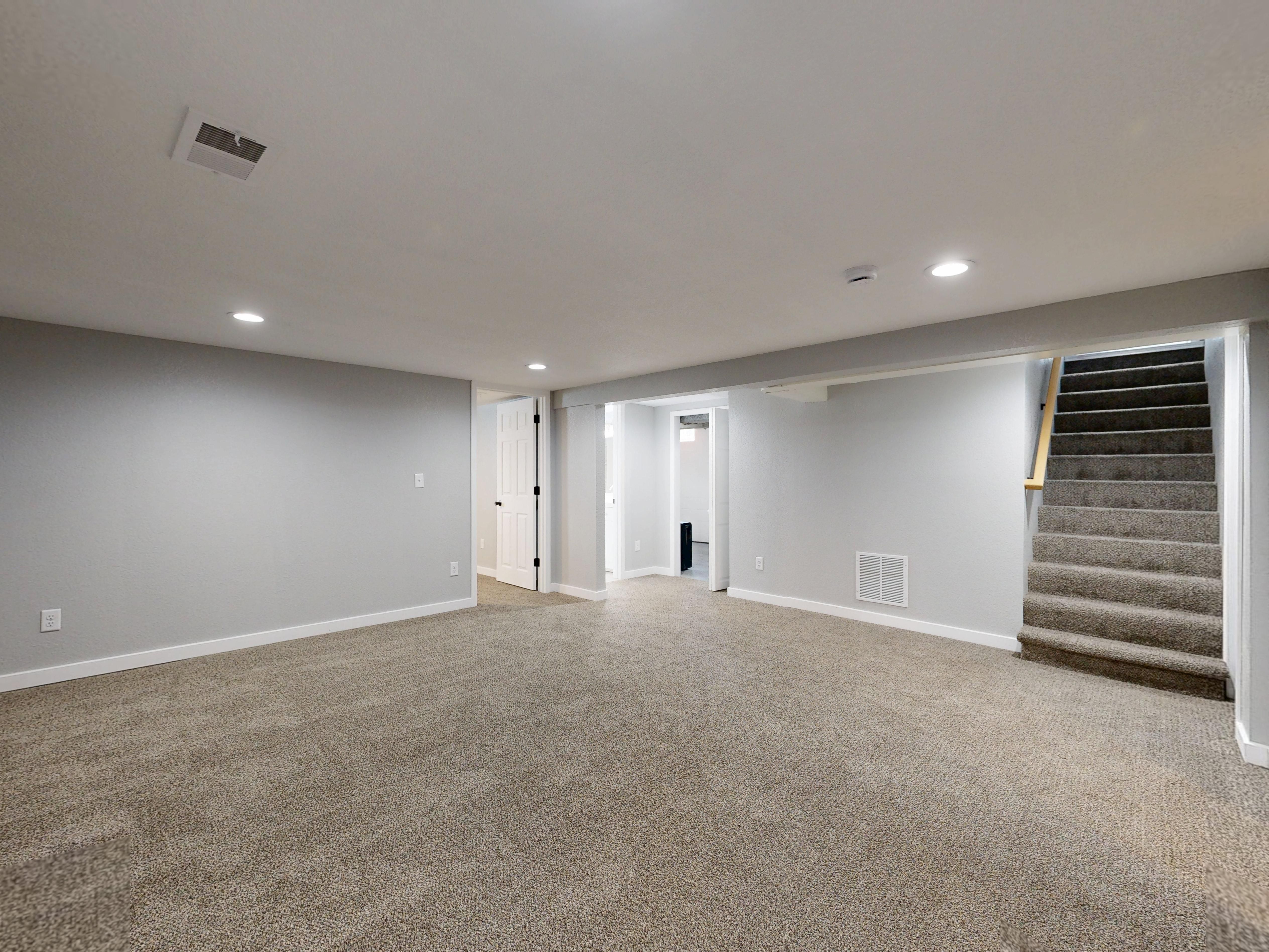
If you're finishing a basement or replacing the flooring in one, there's a good chance you're wondering: What type of flooring is best in a basement?
The answer isn't as simple as choosing the most waterproof flooring you can find.
Basements have different flooring needs than the rest of your home. They're below grade, they're often more susceptible to moisture and humidity, and they can be used for everything from family rooms and bedrooms to home gyms, playrooms, and storage.
At Vonderheide Floor Coverings, we've helped homeowners throughout Central Illinois choose flooring for all kinds of rooms and lifestyles. When it comes to basements, we don't believe there's one flooring product that's automatically the right answer.
Instead, we start with the basement itself.
Start With the Basement, Not the Flooring
Before you start looking at colors, styles, or prices, you need to know what you're working with.
Is the basement completely dry? Has it ever flooded? Do you notice a musty smell? Is there condensation or excessive humidity? Is the concrete slab in good condition?
These questions matter because moisture can change what flooring makes sense for your space.
A basement that has never had standing water can still have moisture issues. Water vapor can move through a concrete slab, and excessive humidity can contribute to odors, mold, and other problems.
If you have an ongoing moisture problem, replacing the flooring isn't going to solve it. That issue needs to be addressed first.
There's also an important distinction that gets overlooked when people shop for basement flooring: waterproof flooring doesn't make a basement waterproof.
For example, luxury vinyl plank and luxury vinyl tile are highly water-resistant flooring options, but they're made up of individual planks or tiles with seams between them. If water gets onto the floor, those seams can potentially allow moisture to reach the material underneath.
So before you ask, "What's the most waterproof flooring I can buy?" ask, "Is my basement an appropriate environment for the flooring I'm considering?"
That distinction can save you from an expensive mistake.
Luxury Vinyl Is a Popular Choice for Finished Basements
For many dry, finished basements, luxury vinyl plank (LVP) or luxury vinyl tile (LVT) can be an excellent choice.
There's a reason we see so much interest in luxury vinyl. It gives homeowners a lot of flexibility in both appearance and performance. You can get the look of hardwood, stone, or tile in a flooring product that's easy to clean and available in a wide variety of styles.
Luxury vinyl can work particularly well in basements being used as:
Family rooms
Rec rooms
Home offices
Playrooms
Home gyms
Entertainment spaces
Guest areas
But don't make the mistake of assuming that all luxury vinyl is essentially the same.
One of the biggest things we look at is the wear layer. If you're putting flooring in a basement that's going to see a lot of traffic, kids, pets, or furniture being moved around, the construction of the product matters.
For homeowners who need a particularly durable floor, we often recommend looking at luxury vinyl with a 20 mil or thicker wear layer.
There's more to choosing the right LVP or LVT than just finding something that looks good, too. The condition of the subfloor, the installation method, the specific manufacturer's requirements, and the way the room will be used all matter.
That's why we don't recommend choosing a luxury vinyl floor based solely on the price per square foot.
Sheet Vinyl Is Worth Considering, Too
If moisture resistance is one of your biggest concerns, sheet vinyl is another option worth looking at.
Unlike luxury vinyl plank or tile, sheet vinyl doesn't have individual planks or tiles with seams running throughout the floor. Depending on the room and installation, that can make it a practical choice where minimizing potential pathways for moisture is important.
Sheet vinyl has also come a long way in terms of appearance. You don't necessarily have to settle for something that looks like it belongs in a utility room. There are plenty of patterns and designs available.
It can make sense for basement bathrooms, laundry areas, utility spaces, or other rooms where practicality and moisture resistance are more important than having a particular high-end flooring look.
And this is another area where our philosophy comes into play: the least expensive flooring isn't necessarily the best value.
If a $2-per-square-foot floor isn't appropriate for the room, it isn't really saving you money.
The right flooring is the flooring that does what you need it to do.
Tile Can Be an Excellent Long-Term Option
Ceramic or porcelain tile is another flooring option that deserves consideration in a basement.
Tile offers excellent durability and is well suited to areas where moisture is a concern. Properly installed tile can last for decades, and ceramic tile can last 50 years or more with proper care.
That makes tile particularly appealing for homeowners who want a floor that they don't expect to replace anytime soon.
Tile can be a great option for:
Basement bathrooms
Laundry rooms
Wet bars
Entry areas
High-traffic spaces
Homeowners prioritizing long-term durability
The downside is comfort.
Tile is hard underfoot and can feel cold, especially in a basement. If you're turning your basement into a cozy family room where people will be sitting on the floor, playing with children, or walking around barefoot, that may be something you want to consider.
On the other hand, if you're creating a basement bathroom or laundry room, the durability and moisture resistance of tile may be much more important than having a soft floor.
Again, it comes down to the room and how you're going to use it.
Is Carpet a Good Choice for a Basement?
This is where we don't like blanket rules.
You've probably heard that you shouldn't put carpet in a basement. That's not necessarily true.
If your basement is consistently dry, properly conditioned, and free of moisture problems, carpet can be an excellent choice.
In fact, if you're turning your basement into a family room, movie room, playroom, or bedroom, carpet can provide something hard-surface flooring can't: warmth and comfort.
But you need to understand the potential downside.
Carpet and carpet padding can retain moisture. If a basement has an ongoing moisture problem, that can contribute to odors and potentially create conditions that encourage mold and mildew.
That's why we wouldn't recommend choosing carpet simply because it's soft or because you've found a cheap carpet sale.
We'd want to know more about the basement first.
If the space is dry and you're looking for a comfortable floor, carpet might be exactly what you need. If moisture is a concern, we'd likely steer the conversation toward other options.
And if you do choose carpet, the type of carpet matters.
A basement family room with kids and pets has very different requirements from a basement guest room that gets used a few times a year. Carpet fiber, stain resistance, moisture protection, cushion, and warranty can all factor into the decision.
What About Hardwood Flooring in a Basement?
Traditional solid hardwood generally isn't our first recommendation for a below-grade basement.
The issue isn't that hardwood doesn't look good. It does.
The problem is the environment. Changes in moisture and humidity can cause hardwood to expand, contract, and move. Below-grade spaces can present more challenges than rooms above ground.
That doesn't mean you're stuck without a wood look.
Luxury vinyl can give you the appearance of hardwood while offering characteristics that can make it more appropriate for many basement applications. Engineered hardwood may also be an option in certain situations, depending on the specific product, basement conditions, and manufacturer's installation requirements.
This is a good example of why we encourage homeowners to fall in love with the look they want before deciding on the material they need.
You might love the appearance of oak flooring. That doesn't necessarily mean traditional solid oak is the best product for your basement.
What About Laminate?
Laminate is another option that can give you the look of hardwood or other materials at a variety of price points.
However, you need to be careful about assuming that every laminate floor is appropriate for a basement.
Different laminate products have different moisture-resistance characteristics and installation requirements. If you're considering laminate, look at the manufacturer's specifications and warranty for the specific product you're buying.
This is another situation where having a flooring professional help you narrow down the choices can be valuable.
You're not just buying a floor. You're buying a floor for a particular room.
So, What's the Best Flooring for a Basement?
There isn't one universal answer.
The best flooring depends on the conditions of the basement, how you use the room, and what you expect from the floor.
If Moisture Resistance Is Your Biggest Concern
Sheet vinyl, luxury vinyl, and tile are all options worth considering, depending on the specific conditions of the basement and the installation.
If You Want the Look of Hardwood
Luxury vinyl can provide a wood-look appearance without automatically putting traditional solid hardwood in a below-grade environment. Engineered hardwood may also be appropriate in certain applications.
If Comfort Is the Priority
Carpet can be a great choice for a dry, properly conditioned basement, especially when you're creating a family room, bedroom, or other living space.
If Long-Term Durability Is the Priority
Tile is worth serious consideration. With proper installation and care, it can provide decades of service.
If Budget Is the Biggest Concern
There are flooring options at a wide range of price points. But don't compare products based solely on their price per square foot.
Consider the product, installation, subfloor preparation, expected lifespan, maintenance, and how well the flooring fits the room.
That's how you get a better picture of the actual value.
Think About How You'll Use the Basement
One of the biggest mistakes we see homeowners make is shopping for flooring before thinking about how they're going to use the room.
A basement that's primarily used for storage doesn't have the same flooring requirements as a basement that's become the most-used room in the house.
Think about what you're creating.
Are you building a family room where everyone gathers to watch movies?
A playroom where the kids will spend hours on the floor?
A home gym?
A guest bedroom?
A basement bar?
A laundry room?
Each of those spaces can point you toward a different flooring solution.
Then think about your household.
Do you have pets? Kids? Do you entertain frequently? Do you need something particularly easy to clean? Are you planning to stay in the house for another 20 years, or are you preparing it for sale?
Those details matter.
That's why when someone comes into Vonderheide Floor Coverings, we don't just ask, "What flooring do you like?"
We want to know what you're going to put the flooring through.
Don't Let the Lowest Price Make the Decision for You
This is something we've talked about with customers for years: the cheapest flooring isn't always the best value.
You can find inexpensive flooring for almost any room in your house. The question is whether it's the right flooring.
A basement is a great example.
Maybe you find an inexpensive carpet that looks great, but your basement has a history of moisture problems.
Maybe you find a cheap luxury vinyl product, but the room gets heavy traffic from kids and pets and a more durable product would make more sense.
Maybe you're creating a cozy basement family room and choose a hard surface because it costs less, only to realize that you really wanted the warmth and comfort of carpet.
In each situation, buying the cheapest product doesn't necessarily save money.
The best value is the flooring that fits the room, your lifestyle, and your expectations, not simply the flooring with the lowest price tag.
Talk to a Flooring Professional Before You Buy
Choosing basement flooring doesn't have to be complicated, but there are enough variables that it's worth talking to someone who works with flooring every day.
At Vonderheide Floor Coverings, we've been helping Central Illinois homeowners choose flooring since 1947. We can help you consider the condition of your basement, how you use the space, the people and pets who will be using it, your style preferences, and your budget.
We'll show you options that make sense for your particular situation rather than trying to force every basement into the same flooring solution.
If you're replacing the flooring in your basement, stop by our Pekin showroom or schedule a free in-home measurement.
We'll help you find a floor that isn't just something you like the look of, it's something that makes sense for your home.
